
World record is a long shot
It was moving at about 660 mph — but it still took about 24.5 seconds.
That’s how far 4.4 miles is when you’re a speeding bullet.
“Because of my physique, I always assumed that if I set a world record it’d be in a hot dog-eating contest or something,” former Jackson Hole police officer Shepard Humphries joked in a Zoom interview from his home in Sublette County. “I didn’t think it would be something that took skill.”
Humphries was talking about what he and buddy Scott Austin, co-authors of “Nomad Rifleman’s Guide to Extreme Long Range Shooting Fun,” and half a dozen friends — including a shooter they’ll identify only as “Winston” — accomplished on the morning of Sept. 13 on a ranch in the Pinedale area.
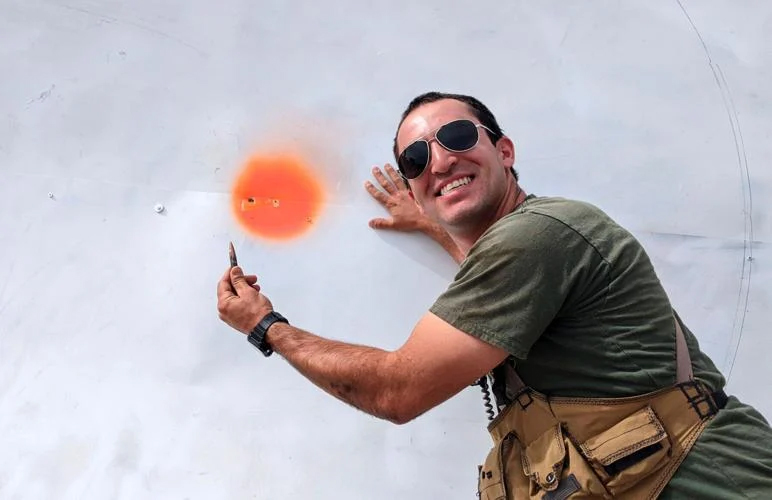
They hit an 8-foot-wide bull’s-eye with a custom-made long-range rifle from the aforementioned distance.
That, Humphries says, is a world record, breaking the one of 4 miles set in 2020 by a team assembled by Paul Phillips, of Midland, Texas.
And it took only 69 shots, the same number of attempts, oddly enough, it took Phillips and company two years ago.
“Just a strange coincidence,” said Humphries, 49. “It could have been day after day after day trying this for years and never getting a hit for 200 shots a day.”
Humphries and Austin and the rest of the team, which included Humphries’ wife, Lynn — the Humphries run Jackson Hole Shooting Experience — were astonished that they pulled it off.
“It was really neat how long the bullet was in the air,” Humphries said. “Which was, I’m not going to say luck. But hitting an 8-inch circle at that distance was, we had a good day. The winds were smiling on us.”
This isn’t exactly new territory for Humphries, who two years ago helped a client shoot a target 3.06 miles away in another undisclosed location. But when Phillips broke that record, Humphries and Austin began their quest to top the 4-mile mark.
“We have to go further than that,” Humphries thought. “And we debated going 4.1 miles or 4.2 or 4.3, and we finally kind of decided on 4.4. So we started looking into what kind of gun to have and cartridges …”
The custom-built rifle they assembled, which cost more than $20,000 to build, Humphries said, took more than a year to assemble with parts they ordered from all over the world, from South Dakota to New Zealand.
The rifle, which Humphries calls “a space-aged piece of beauty,” that fired 422-grain (less than an ounce) bullets out of a .416 Barrett chamber was assembled by Scott Null of S&S Sporting in Driggs, Idaho. It has a Vortex Razor scope made by Vortex Optics.
But why shoot a bullet out of such a contraption at a target 4.4 miles away?
“For us, it is purely fun,” said Humphries, whose Jackson Hole Shooting Experience opened in 2010 is described online as the “best family activity in Jackson Hole!”
Humphries, a former Orange County (California) sheriff’s deputy who was born and raised in Tennessee and moved to Jackson Hole when he was 16, has never been a hunter and describes himself as anti-war and said this type of gun or shooting distance is not recommended for hunting. It’s purely for the challenge and the love of marksmanship and long-range shooting.
Austin, the dean of students at Jackson Hole Bible College, was the brains behind the record shot, Humphries said. Austin did the math and led development of the gun, Humphries said.
Perhaps the greatest challenge, though, was finding a spot to make the attempt.
“Hundreds of hours talking to people, getting told no, driving around,” said Humphries, who wouldn’t disclose where the shot was made, only that it was private property near Pinedale.
“Just like your favorite hunting spot or fishing spot, that’s our little secret,” Humphries said.
Every time they thought they’d found a spot, something would go wrong, he said, “a house between, or a road, or something that really would be safe, but the optics wouldn’t be good of shooting over someone’s house, even though it’s very safe,” Humphries said.
The shots were fired by Winston about a half-mile above ground, he said. While Humphries and Austin were at the firing site, a team of spotters, including his wife, were near the target site in specially built steel bunkers made of 3/16th-inch material to keep them safe. And they used their ears, not their eyes, to determine how close the shots by “Winston” were coming to the target.
During testing there wasn’t enough “dust signature” from a 422-grain bullet landing at 689 feet per second to see the impact point, according to a press release about the project. But the spotters, often Humphries and his wife, could hear a whistle or a thump somewhere behind or between them while standing more than 100 yards away from the target.
They needed to get closer. They settled on what Humphries thinks might be a new concept in extreme long-range shooting: audible spotting. Thus, the steel bunkers were developed.
Austin served as the coach for Winston on shooting day. Humphries handled radio communications with five spotters 4.4 miles away.
Just after 7 a.m., Winston sent the first shot, which landed about 30 yards from the target based on audible estimates from those in the five bunkers.
After hours of shooting and adjusting the aim of the rifle and the scope, the spotters heard “the reverberation of metal being hit” just before noon. Three of the spotters thought a bullet had hit the top of Lynn Humphries’ bunker, her husband said.
But it hadn’t. None of Winston’s 69 shots ever hit a bunker. It was the target, made of a wood frame and two sheets of thin metal. All five spotters approached and made the confirmation.
“We have our first hit! Confirmed! Confirmed hit!” one of the spotters radioed back.
The impact point was on the left edge of an 8-inch orange circle painted in the center of the 8-foot bull’s-eye — 3 1/2 inches from dead center.
Shep Humphries and Austin are quick to point out that this is not a “scientifically repeatable thing.” There are too many variables.
“By no means I’m I claiming that I could go out and do this tomorrow,” Humphries said.
Mark Baker has been a journalist for over 20 years. He’s reported for newspapers in Oregon, Washington, California, Alabama and Wyoming.