
Head games: Seeking consensus on concussion
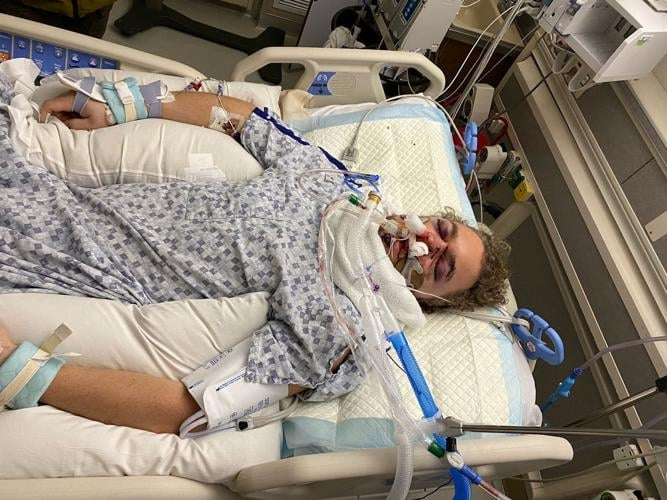
Four days completely gone.
“I didn’t know what happened to me,” Ethan McLeod said. “I thought I had COVID.”
Nope. Just a broken face — and a traumatic brain injury.
After he crashed while downhill skiing at Grand Targhee Resort in Alta on Jan. 9, 2022, McLeod, 27, was life-flighted to Eastern Idaho Regional Medical Center in Idaho Falls. But no one knew who he was. He’d been skiing alone and left his ID in his car.
Friends finally tracked him down and alerted his parents in Boise, Idaho. A doctor offered to do the facial reconstruction surgery that McLeod needed, but he’d never done it before, McLeod said.
So McLeod was flown to the University of Utah Medical Center in Salt Lake City. That’s where he regained consciousness — a tube doing his breathing for him, his jaw wired shut — on Jan. 13, 2022. And that’s where he had the surgery to put his face back together.
The best he can figure more than a year later is that he hit a tree after skiing somewhat recklessly that day. Someone found him there, at the base of a tree. He thinks he’d been there for at least 15 minutes.
McLeod is one of the lucky ones.
According to the Centers for Disease Control and Prevention, about 1.5 million Americans sustain traumatic brain injuries annually and about 230,000 of them are hospitalized. Of those, about 50,000 people die each year from their injuries.
But not everyone who hits their head skiing or playing hockey or just falling down the stairs at home gets medical care. Many are not even sure what happened. They’ve simply sustained a concussion, which is a type of traumatic brain inury that happens when the head and brain move rapidly back and forth.
About 1.6 million to 3.8 million Americans sustain a sports- and recreation-related concussion annually, according to the CDC.
And when it comes to contact sports, dealing with concussions and concussion protocol and managing symptoms and treatment is an inexact science that continues to evolve, especially in a place as active as Jackson Hole.
From downhill skiing to ice hockey to mountain biking, not to mention youth and high school sports such as football and soccer, there’s no shortage of opportunities for the human skull to come in contact with the ground, the ice or another athlete.
But how do you lower the risk? Should kids not play contact sports? Should a concussion signal an automatic end to a player’s season?
“The sport isn’t the problem,” said Hayden Hilke, owner of Peak Physical Therapy in Wilson. “It’s how we manage these incidents and these injuries.”
Hilke also runs Watershed Jackson, a nonprofit organization that aims to raise awareness regarding area athletes who have sustained spinal cord or traumatic brain injuries. He and other stakeholders thought they had a solution back in 2019 to lower the concussion rate and generally improve outcomes, by providing annual concussion baseline-testing and introducing a concussion management plan via medical providers, St. John’s Health, physical therapists and the Teton County School District, among others.
But then came the pandemic.
“We were just gaining momentum, and then the bottom fell out,” Hilke said.
In November 2019, Hilke spearheaded a concussion baseline screening night at Snow King Sports and Events Center, uniting medical providers, physical therapists, speech-language pathologists and St. John’s Health to build a community plan around concussion protocol.
Youth athletes from Jackson Youth Hockey and the Jackson Hole Ski and Snowboard Club, among others, received baseline tests that measure brain function, which can later help diagnose concussions through comparative testing.
A few months before that evening at Snow King a newly formed concussion support group met in a common area of St. John’s Health. Chris Smithwick, a speech-language pathologist with Teton Physical Therapy and Rehabilitation who would later choose the tests for that baseline screening night, and Oliver Goss, a St. John’s social worker, organized the group.
About eight people showed for that first monthly group in the spring of 2019, Smithwick said. But it lasted only around five months, he said, as attendance tapered.
“I’ve been asking myself, ‘Why did that happen?’” Smithwick said earlier this month.
Summer came and people got busy. It’s hard to push through summertime traffic to get to a late-afternoon meeting on the east side of Jackson. Maybe the meetings needed to be held more often?
Whatever it was, Smithwick and fellow Teton Physical Therapy therapist Margaret Blair put in countless volunteer hours developing the baseline testing program, said Lindsay Love, director of rehabilitation at Teton Physical Therapy.
“The hours that those two spent developing this program and pouring into this was remarkable,” Love said, sitting in her office at Teton Physical Therapy in East Jackson.
Love and Hilke did a lot of work together, too, trying to get a community-based concussion plan off the ground.
“Our real goal was to have everybody have these baseline screens, everybody who was involved in club or any organized sports in town, so they had just something to give us a measure to look back at. We did a lot of research.”
The thinking was, “Let’s get in on this at the forefront, and let’s be one of these models for a community-based concussion program,” Love said. “And I am 90% sure that we would have gotten to a place that was really good and useful and well received with some tweaking and changes and we were on that path if we hadn’t had that [pandemic] shutdown.”
The shutdown, of course, affected staffing and resources.
“It was all professional staff volunteering time to provide these [baseline] screens, which is difficult to sustain,” Love said. “We needed a lot of volunteers for each team.”
As they began running out of volunteers to staff the effort, the goal shifted to organizing a baseline testing day for the Teton County School District student-athletes.
“And we had it pretty dialed at that point, how it worked,” Love said. But, again, then came COVID in 2020. And then came the staffing shortages.
“Even if we reinvented how we were going to do things, health care was in a different place, so we were dealing with COVID and not dealing with concussion or a lot of other things. … at that time,” she said.
But a lot of parents still want their children baseline-tested before playing contact sports, Love said. So Teton Physical Therapy still provides that, but it’s not free.
Cumulative impact
Hilke said the No. 1 sport she receives calls about is hockey.
“I get four or five calls a season,” she said, from parents whose children sustained a concussion or are suspected of sustaining one.
But not all youth hockey teams baseline-test, she said. It depends on the team and the parents, Hilke said.
“I definitely see it vary from program to program,” said Dr. Travis Riddell, a Jackson pediatrician and Teton County’s health officer. “It seems like the schools are more on top of it than the club sports, and definitely more driven by parents.”
Riddell doesn’t see a need to mandate public baseline scoring for student-athletes because it’s “not a public health threat.” But if baseline testing allows for a better diagnosis of concussions and for better management of head injuries, “then why not do it, from a parent perspective?” he said.
“I worry about the cumulative impacts of these [concussions],” Riddell said. “Even sub-concussive,” a bump or blow to head that doesn’t cause symptoms, “blows can have an effect over time.”
That’s why baseline testing is so important, experts say.
“I think that’s sort of what we would like to see happen, where it’s just normal to see the kid’s base-lined,” Hilke said. “But I don’t know of any community that’s been able to sustain it.”
A sustaining concussion management program — where student-athletes are regularly given baseline tests, where coaches and trainers regularly give sideline tests that compare scores to those baseline tests, where there is a flow chart of treatment protocol around head injuries — St. John’s Health needs to be a major player, Hilke said.
“I’d love to see it be in place again,” Dr. Jim Little Jr., chief of staff at St. John’s Health, of the concussion program that was gaining momentum. “But we can’t do it by ourselves. We can’t take care of all the baseline testing.” The hospital would need volunteers in the form of therapists, trainers, parents, etc., Little said.
‘I have a story’
Whatever happens, McLeod, who endured a face-shattering concussion on the slopes of Targhee, wants to be involved.
“Just so people can have support,” said McLeod, who today has only a small scar on his chin to remind him of what happened.
But the head injury you don’t see. The damage to the frontal lobe of his brain, you don’t see.
He had trouble with multitasking and impulsivity for months, he said. He did physical therapy and occupational therapy and speech therapy at a neuro outpatient program in Idaho. He was eventually OK’d to drive a car again. He has three metal plates in his face from the surgery.
“I learned a lot,” said McLeod, who was able to go stay with his parents in Boise for months and slowly recover and who recently returned to the slopes. “And I have a story, and I think there’s value in that story.”
McLeod said he was able to recover and is doing well today “because I had the tools and resources, but I realize that a lot of people who get brain injuries don’t have that.”
He was insured under the Affordable Care Act and he was able to sleep whenever he needed to at his parents’ home in Boise.
“It has changed my life in general,” McLeod said.
He recently reached out to both Hilke and Smithwick and is taking the lead on reestablishing a concussion/TBI support group.
“There’s definitely interest in it,” Smithwick said.
Smithwick and Riddell both mentioned research in the last decade that disputes the ages-old theory that all concussion sufferers need to sit in a dark room and remain inactive for weeks.
“One of the hardest things that people experience with concussion is that it can be really confusing, the balance between doing too little or too much,” Smithwick said. “What is the balance?”
Do too much too soon and it can be overwhelming, he said. But do too little and then symptoms might not improve.
“Graded exposure” is the answer, Smithwick said. That means a gradual return to school or work or athletics.
It’s a “big myth” that all concussion sufferers should retreat and avoid activity, he said.“If you can tolerate mild symptoms, that’s a good sign.”
Hilke is hoping momentum to the concussion debate in Jackson can be restored before a real tragedy happens.
“I think it’s the best community in the entire universe, and we could do anything together,” Hilke said. “It just takes a lot of factors to get the ball back rolling. We lost a lot of momentum.”
“Unfortunately, it takes something happening before everyone says, ‘Oh wait a minute, did we have a plan?’”
Mark Baker has been a journalist for over 20 years. He’s reported for newspapers in Oregon, Washington, California, Alabama and Wyoming.