
Top of the world, again
Jackson Hole’s Ben Jones is among the most prolific climbers in U.S. history
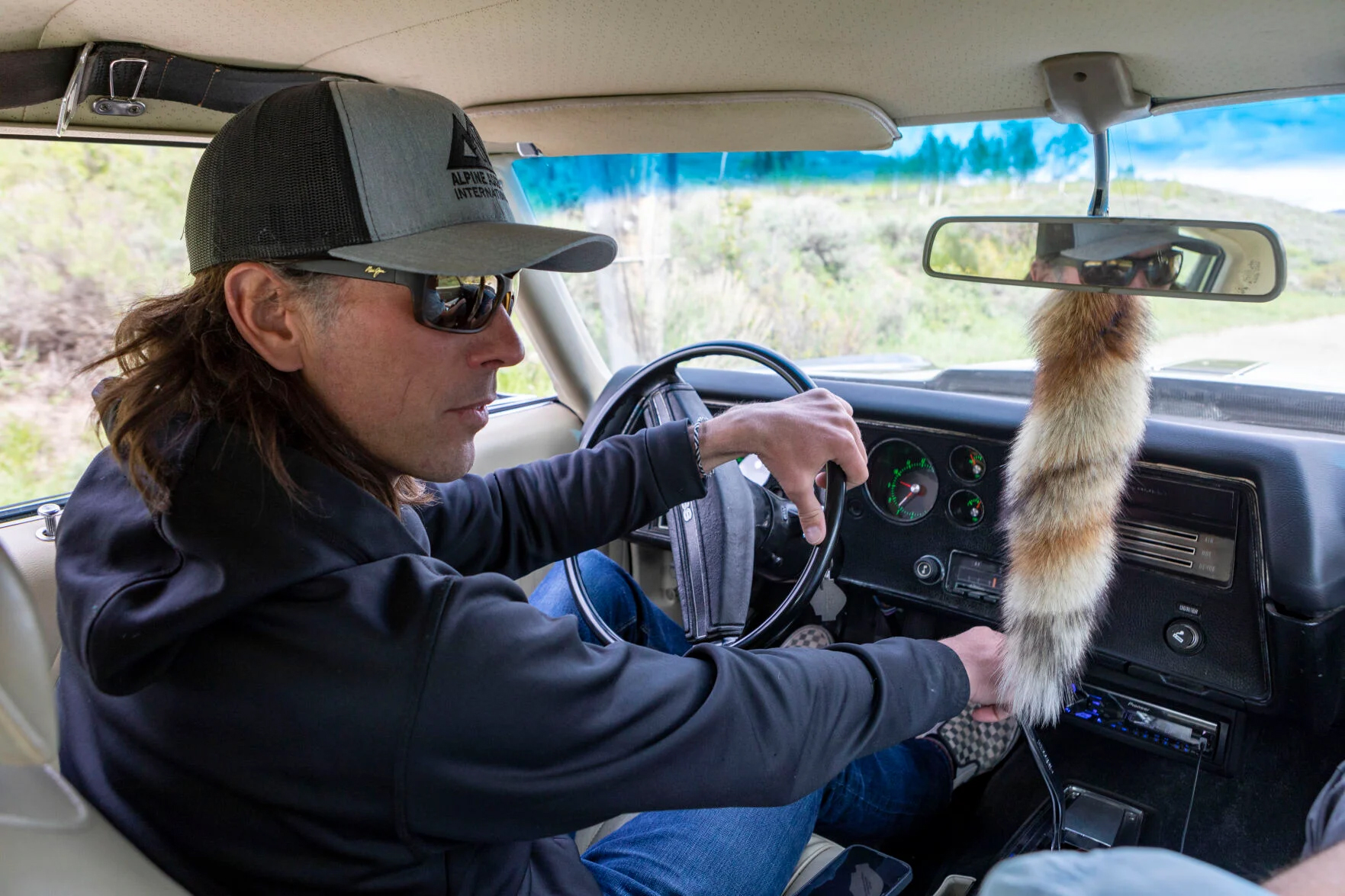
We’re flying up Highway 89 toward Jackson, the Teton Range in the distance, the engine of the black 1971 Chevrolet Chevelle once owned by actor Michael Madsen of “Reservoir Dogs” fame rumbling away.
This is what Ben Jones does to relax. This is horizontal Ben Jones — not vertical Ben Jones.
This is Ben Jones testing the speed limit, not the Ben Jones who takes one slow, methodical step after another when he’s doing what a tiny percentage of human beings have ever done: hike to the top of the world, and then do it all over again.
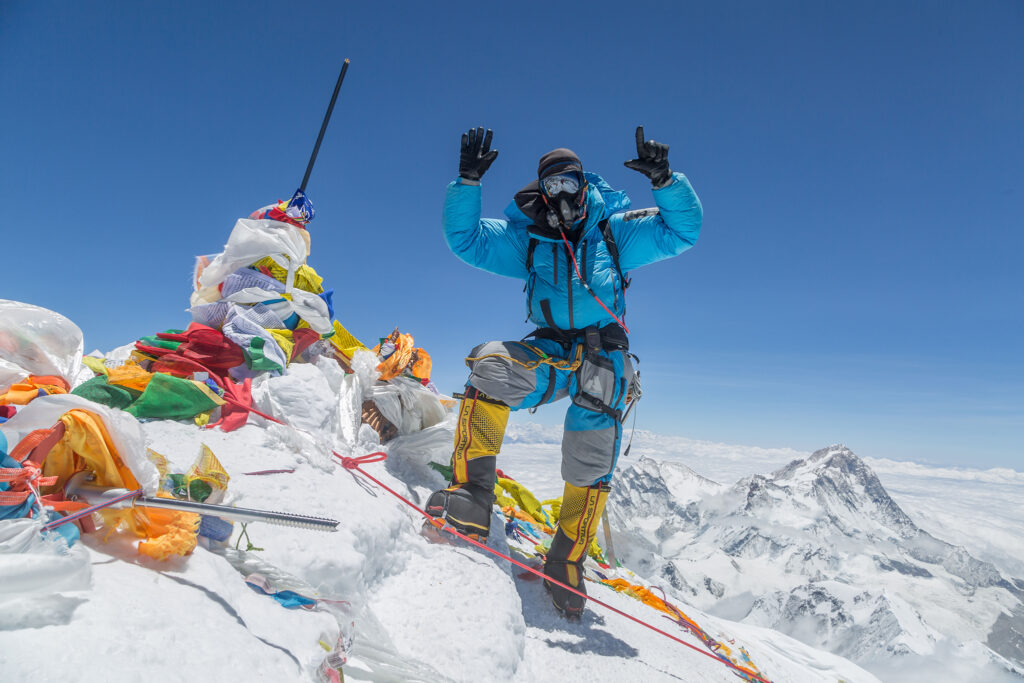
A climbing guide for Seattle-based Alpine Ascents International and a Jackson Hole resident since 2003, Jones has not only summited Mount Everest, the world’s tallest peak at 29,031 feet, but done it seven times, and he’s climbed the Seven Summits — the tallest mountain on each continent — dozens of times. Jones has led 36 expeditions up Tanzania’s 19,341-foot Kilimanjaro, which he plans to scale three more times this summer; 12 ascents up Aconcagua, South America’s highest peak at 22,837 feet; nine ascents of Denali, the Alaskan peak that’s North America’s tallest at 20,310 feet; nine ascents up 16,050-foot Mount Vinson in Antarctica; and two ascents each of Mount Elbrus (the most prominent peak in Russia and Europe at 18,510 feet) and Carstensz Pyramid (the 16,024-foot peak on the island of New Guinea.)
The 43-year-old Jones, who completed his seventh expedition up Everest on May 18, said he’s been living this mountaineering life for 20 years now for several reasons: “Partially the lifestyle, being able to travel around the world. And I do love teaching people and being a part of their once-in-a-lifetime trips and seeing the enthusiasm and just the drive for people to achieve their goals is just supercool to be a part of.”
Jones’s seventh ascent of Everest puts him in rare company. It might not be close to the world record for Everest climbs, which belongs to Nepal’s Kami Rita Sherpa — who on May 7 summited the mountain for a remarkable 26th time — but it puts Jones among maybe a dozen Americans who have scaled Everest seven or more times, said Todd Burleson, Alpine Ascent’s director and founder. Various lists show that American Dave Hahn, a New Mexico-based climbing guide, holds the U.S. record, with 15 Everest ascents. A listing on Minnesota-based High Adventure Expeditions includes a few other Americans who have double-digit Everest climbs, and several others with five or more, including Jones with six, as of December 2021.
“He’s kind of quiet, to some degree,” the Alaska-based Burleson said of Jones. “And you think: How does he lead? But people are attracted to him. And he’s very smart.”
And how does a kid from Indiana, where the highest point in the state, Hoosier Hill, is a mere 1,257 feet above sea level, become one of the most prolific mountain climbers in American history?
‘Classic American road trip’
Born in Bloomington, Indiana, in 1979, Benjamin Mason Jones grew up the middle son of three boys in a typical all-American family. There was no mountain climbing in 1980s Indiana, but his parents did expose him and his brothers to camping and the outdoors, the soft-spoken Jones said. He played ice hockey and skateboarded and, of course, played basketball in the hoops-obsessed Hoosier State.
But it was a “classic American road trip” that included Jackson Hole and Grand Teton National Park the summer he was 13 or 14 that would plant the seed for a life dedicated to scaling the world’s highest mountains.
Jones saw the stunning beauty of the Tetons for the first time “and immediately fell in love with just being out West,” he said.
He got into rock climbing, mostly at indoor gyms, in his late teens. He perused mountaineering books and “for whatever reason, I wanted to climb these big, snowy peaks around the world,” Jones said.
And in 1997, his senior year in high school, he read a book that changed his life — Jon Krakauer’s “Into Thin Air,” the best-seller that details the writer’s harrowing experience climbing Everest in May 1996, an expedition that claimed eight lives.
“So many people, I think, were drawn to Everest because of that book,” said Jones, sitting in the sunlight near the end of the large garage he rents from a friend near Hoback Junction to store his Chevelle, climbing equipment and other belongings.
The numbers tell the story: At the end of the 1980s, more than 36 years after New Zealand’s Sir Edmund Hillary and sherpa Tenzing Norgay became the first human beings to summit Everest on May 29, 1953, about 320 people, including 28 Americans, had summited the mountain, according to most lists.
Those numbers would triple in the 1990s as companies like Alpine Ascents, begun by Burleson in 1986, were taking more and more people up the mountain.
In the 21st century, Mount Everest summits have climbed into the thousands, topping 10,000 earlier this year, although many of those have been completed by the same people, such as Jones, making the number of people to have scaled the mountain just more than 6,000, according to High Adventure Expeditions.
‘Getting into the Tetons’
Jones’ ascent to becoming not only one of those 6,000 but one to do it seven times over was inspired by one of his professors: Alan Ewert, at Indiana University. After a year spent in Montana following his 1997 high school graduation, Jones enrolled at his hometown university. He had no particular focus in college, majoring in general studies, but in his final semester, in 2002, Jones participated in an outdoor education program. He learned about mountaineering, caving, canoeing and other outdoor pursuits and worked for some adventure team-travel companies.
That summer after graduation, Ewert, whom Jones considers a mentor, invited him to climb Mount Hood, the 11,249-foot peak east of Portland, Oregon. It was less than a month after three climbers were killed and four others were injured on Oregon’s highest peak after falling into a crevasse, a story that was punctuated by the crash of an Air Force helicopter sent to rescue the climbers.
Jones, Ewert and one of his assistant professors got “stormed off” Hood in that first attempt, but came back two days later and successfully summited the mountain, Jones said. Then they climbed 14,441-foot Mount Rainier near Seattle. Jones was hooked. They went to British Columbia and attempted to climb 11,453-foot Mount Athabasca but were derailed by bad weather. Jones then spent some time in Colorado for more training in mountaineering.
He moved to Jackson Hole in the winter of 2003-04, taking a “mountain op” job at Jackson Hole Mountain Resort. He drove children attending the resort’s Kids Ranch, as well as their instructors, up ski runs by snowmobile. Jones also worked the front desk at the Teton County Recreation Center.
In the spring of 2004 he enrolled in an instructor course program to learn how to become a guide at the National Outdoor Leadership School, or NOLS, in Alaska. Jones spent three years working for the nonprofit outdoor education school, doing several trips for it.
“For whatever reason, I was just attracted to the high mountains,” said Jones.
He has climbed the 13,775-foot Grand Teton four times and loves “getting into the Tetons” but prefers the adventure and intrigue of scaling the world’s highest peaks and helping others do the same.
Death on the mountains
All that training and ambition led to a job in 2008 with Alpine Ascents, which started as a small company more than three decades ago focused on Mount Rainier climbs. Today the company contracts with more than 60 guides, Burleson said. Jones began as an assistant guide, learning from others.
“He came with experience,” Burleson said. “NOLS is a really good program. Ben was quickly on the whole [Alpine Ascents] circuit. He just excelled. And he had a passion for the Himalayas.”
Jones first summit of Mount Everest came in May 2011, as an assistant guide with two more experienced guides leading; then he climbed Mount Lhotse, also on the Nepal-China border and the world’s fourth-highest mountain at 27,940 feet, on his own in 2012.
“Incredible opportunity,” said Jones, who hasn’t cut his long, dark-brown locks since COVID hit more than two years ago, of his first Everest summit in 2011. “I was super-lucky to be able to go. My role was just to be able to learn the route and to hopefully be able to become an Everest guide.”
Six Everest expeditions later that dream has been more than fulfilled. “It’s still a really incredible mountain,” said Jones, who first led an expedition up Everest himself in 2016. “It’s one of the most beautiful places I’ve ever been. But going through the famous Khumbu Icefall was just, you know, pretty wild. It’s hard to describe, but it’s just these enormous chunks of ice towering over you. Up and down — all through there.”
The Khumbu Icefall on Everest’s South Col route is the most dangerous part of climbing the mountain, Jones said. Of the more than 300 documented climbers who have lost their lives on Everest, many have died there, including 16 sherpas on April 18, 2014, crushed under house-sized ice chunks, according to a 2019 New York Times’ story that also revealed there may be as many as 100 corpses on Everest, many now exposed by global warming.
Five of those sherpas who died in 2014 were employed by Alpine Ascents, according to a Seattle Times story. Less than two months later the company lost four climbers and two guides in the worst climbing accident on Mount Rainier in more than 30 years when they all fell more than 3,300 feet on May 31, 2014.
“Obviously this is a tragedy,” Burleson told the Times after the accident. “We are very sad for the families and the loss of our guys. Everybody mourns this.”
Jones was on Everest in 2014 when the ice avalanche struck, as was Jackson’s John Griber, another local who’s summited Everest more than once, having done it in 2007 and 2009.
“So emotional,” Griber, 56, recalled. “It was a heavy time being there.”
Griber, inducted last week into the Jackson Hole Ski and Snowboard Club Hall of Fame for both snowboarding and his work as a mountaineering cinematographer, was on Everest that day “to film this guy who was going to jump off the top in a squirrel suit,” Jones said with a laugh. Joby Ogwyn, who was actually going to try to leap off the top in a wingsuit, was going to do it live on the Discovery Channel, but the worst avalanche in Everest history ruined any chance of that, as well as any chance that Jones and his party would summit Everest that year.
Or in 2015.
‘I’ve been very fortunate’
Jones was on his fourth expedition up Everest as an assistant guide on April 25, 2015, when a 7.8-magnitude earthquake struck Nepal, triggering another avalanche, this one into Mount Everest Base Camp. The quake killed around 9,000 people in Nepal, and 22 on Everest, either buried at base camp or up on the slopes. Jones was at a lower village just a few hours away, but he and others felt the tremor and ran outside and watched as the mountain above them rumbled, he said.
“It was awful,” Jones said. “Two years in a row of just a lot of death.” But there he was a year later, successfully playing lead guide.
“He’s really level-headed,” Griber said of Jones. “He’s incredibly knowledgeable. He’s been there so many times.”
That’s why Jones is now one of Alpine Ascent’s go-to guides for Everest, said Burleson, who first summited the wicked peak in 1992, and who was on the mountain in 1996 when Krakauer and crew ran into trouble. Burleson helped rescue Texas pathologist Beck Weathers, part of Krakauer’s expedition, who was blinded by the high altitude because of previous eye surgery.
Jones said he’s been lucky to have no major injuries in his climbing career, the closest call being a 28-foot fall years ago while leading an expedition in British Columbia’s Waddington Range for NOLS. It was “like slow motion,” Jones said, but he landed on a ledge and was OK.
“I’ve been very fortunate,” he said.
A couple of Jones’ climbers have had scares on Everest, the closest call coming last spring, Jones’ first attempt on Everest since 2019, COVID-19 cancelling the 2020 trip.
“One of our climbers was with a sherpa, a little bit behind the main group,” Jones said. “And this big part of the Khumba Icefall just collapsed and they got partially buried with these big ice chunks.” The man injured a leg. He and the sherpa were flown by helicopter to Kathmandu, Nepal’s capital.
“It was a pretty close call,” Jones said.
Be like Vern
Climbing Mount Everest, a two-month process from start to finish, or any of the Seven Summits’ peaks through Alpine Ascents, or any mountaineering company, is expensive. Many of Alpine Ascents’ clients are trying to eventually do all seven, Jones said.
That will cost you.
Climbing Everest next spring, between April 1 and June 6, is listed at $70,000 on Alpine Ascents’ website. That includes everything, airfare and all the equipment you’ll need, from high-altitude mountaineering boots, like the black-and-yellow ones Jones has in his garage, which can run as high as $1,000, to your ice ax, 40-foot accessory cord, crampons, climbing harness, trekking poles, parkas, climbing helmet, face mask and headlamp, among other items.
Of course Jones or any other Alpine Ascents guide won’t take you up there if you’re not ready. That means having previous experience climbing a 20,000-foot-plus peak, being in top “physical, emotional and psychological” condition and having the ability to handle extreme cold and altitude.
The company recommends taking a six-day, $1,000 training course on 10,781-foot Mount Baker in Washington if you have aspirations of climbing Everest or another of the world’s highest mountains.
“You’ve got to know if you love it,” Burleson said.
Jones, who like other guides, is paid by contract per expedition, clearly does. He completes 10 to 12 expeditions every year, flying out of Jackson, to Salt Lake City, to wherever.
It hasn’t made him rich, but it’s a living.
“Yeah, can be,” Jones said. “Especially when you live in a van by a garage.”
Jones bought a Ram ProMaster 2500 van last year that’s almost 18 feet long and almost 8 feet tall. That’s where he sleeps, in the bed that stretches across the back of the rig. To get around Jackson Hole, or just to unwind, he drives the beloved Chevelle that he bought online from a California used car dealer in 2019.
As for his future, Jones said he’ll guide fellow humans up the tallest peaks on the globe as long as he can.
One of Alpine Ascents guides, Vern Tejas, is 69 and still climbing.
“I think he’s on Denali right now,” Jones said of the Portland native who holds several world records, including climbing the Seven Summits in just 134 days in 2010 at the age of 57. Tejas also got married on top of Mount Vinson in 2007.
“I always used to say I didn’t want to be like Vern,” Jones said. “But I can quickly see myself getting there. I don’t know. As long as my body holds up, and as long as I’m still having fun, I can’t think of anything else I’d really want to do.”
Second-place award for best sports feature story in annual Wyoming Press Association contest

Mark Baker has been a journalist for over 20 years. He’s reported for newspapers in Oregon, Washington, California, Alabama and Wyoming.